
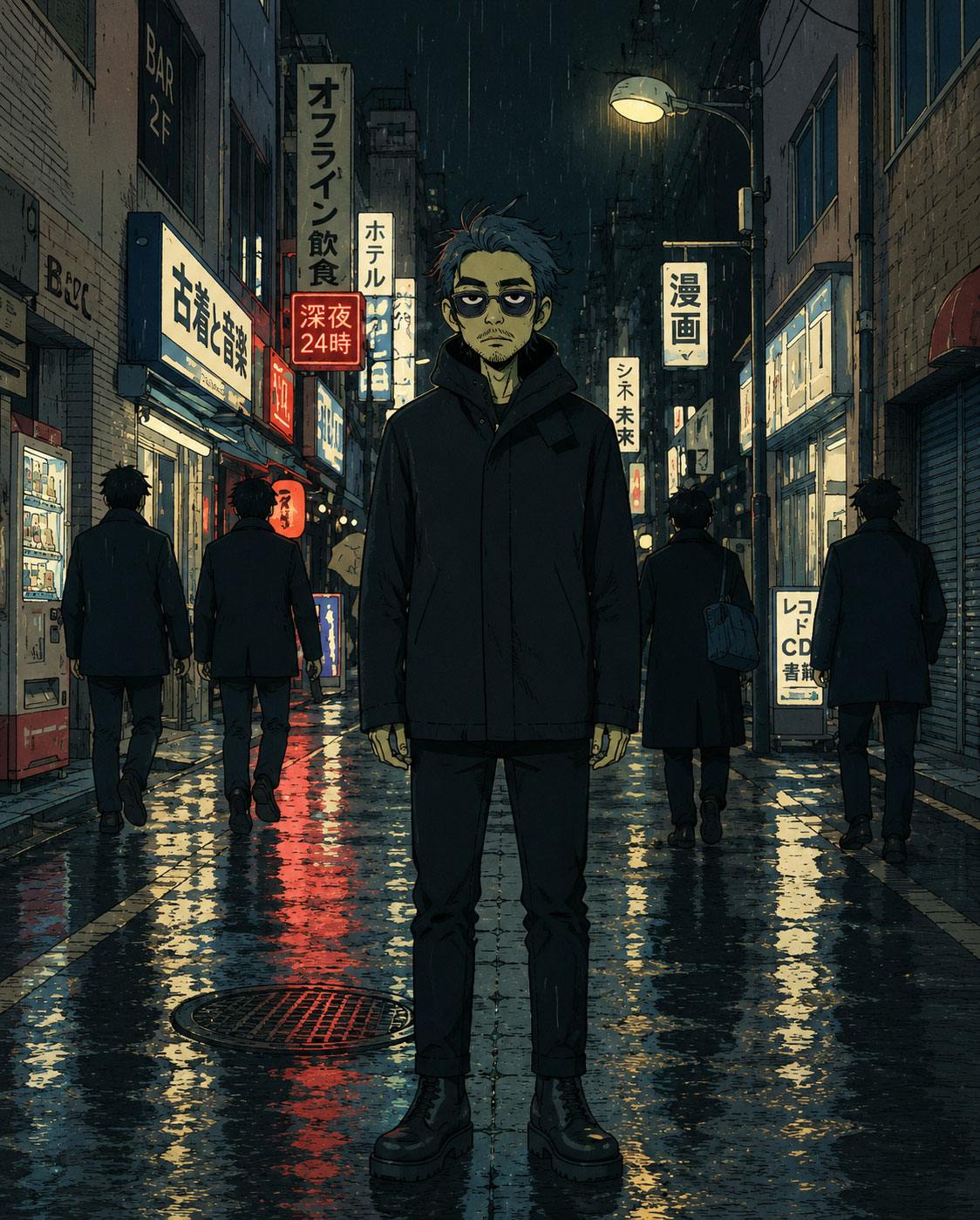

Everyone says opiumcore is just all black. They’re wrong.
A fully black outfit guarantees as much opiumcore as a black turtleneck guarantees a funeral — which is nothing at all. The people selling it as “dark streetwear with skull chains” have confused the label, the artist, and the era with a Halloween party. Which is fine if you want to miss the point. Most people do.
Here’s what actually happened.
Playboi Carti launched his label Opium in 2017. Not 2020, not 2023 — 2017. Ken Carson, Destroy Lonely, Homixide Gang came through the roster. The sound was dark trap bleeding into punk, rage rap with a vampiric undertow. The clothes followed the music the way clothes always follow music when the music is doing something real. All black. Rick Owens silhouettes. Hedi Slimane’s Saint Laurent era as the DNA. Broken textures, narrow cuts, silver hardware only — never gold. The 95% black rule wasn’t a rule anyone wrote down. It was just what the aesthetic demanded.
What Carti did wasn’t invent any of this. Rick Owens had been doing avant-goth since 2004. Hedi Slimane at Saint Laurent from 2012. Trent Reznor in the 90s. The visual language existed across the avant-goth spectrum for two decades before Atlanta touched it. Carti’s contribution was compression — he took everything that was scattered across Parisian fashion houses and Berlin club culture and packed it into an outfit a 19-year-old in Atlanta could understand instantly. That’s not nothing. That’s actually everything. That’s how aesthetics move.
Then Whole Lotta Red dropped at the end of 2020 and the Vampire-Punk phase went fully public. The album was divisive — still is — but the visual language around it was not. Black leather. Exaggerated shoulders. Skinny silhouettes underneath. Futuristic eyewear with silver frames. Cross jewelry. Lug sole boots, black sole only, mid-height or higher. No sneakers. The specific details mattered because in opiumcore the details are the language. Get one wrong and you’re not doing opiumcore, you’re doing a costume.
The TikTok numbers arrived next. The hashtag hit 456 million views in a year. Up 1775% in three months at its peak. The countries driving the numbers weren’t Los Angeles or New York — they were Belarus, Estonia, Latvia, Czechia. Eastern Europe adopted an Atlanta rap label’s aesthetic and made it their own. Fashion has always moved that way, away from its origin point and toward the places that need it most.
By 2025 the aesthetic had reached a place most subcultures don’t survive reaching — high fashion adoption without dissolution. Balenciaga was already in the DNA. Raf Simons. Chrome Hearts. The difference between opiumcore and every other -core that got absorbed into the mainstream and died is that opiumcore had actual rules. The 95% black. The silver hardware. The specific silhouette relationships. The shoe requirements. When a look breaks a rule it stops being opiumcore and becomes something else. That specificity protected it.
What it actually is, underneath all the TikTok boards and Pinterest saves, is the same thing punk was and the same thing hip hop was before either of them got comfortable. A set of signals for people who needed a way to communicate something about themselves to other people who would recognize it. A uniform that isn’t a uniform. A darkness that isn’t costume.
Sato wore all black before it had a name. He’ll wear it after the name is forgotten.
ALL CAPS. ALWAYS.
— Sato