
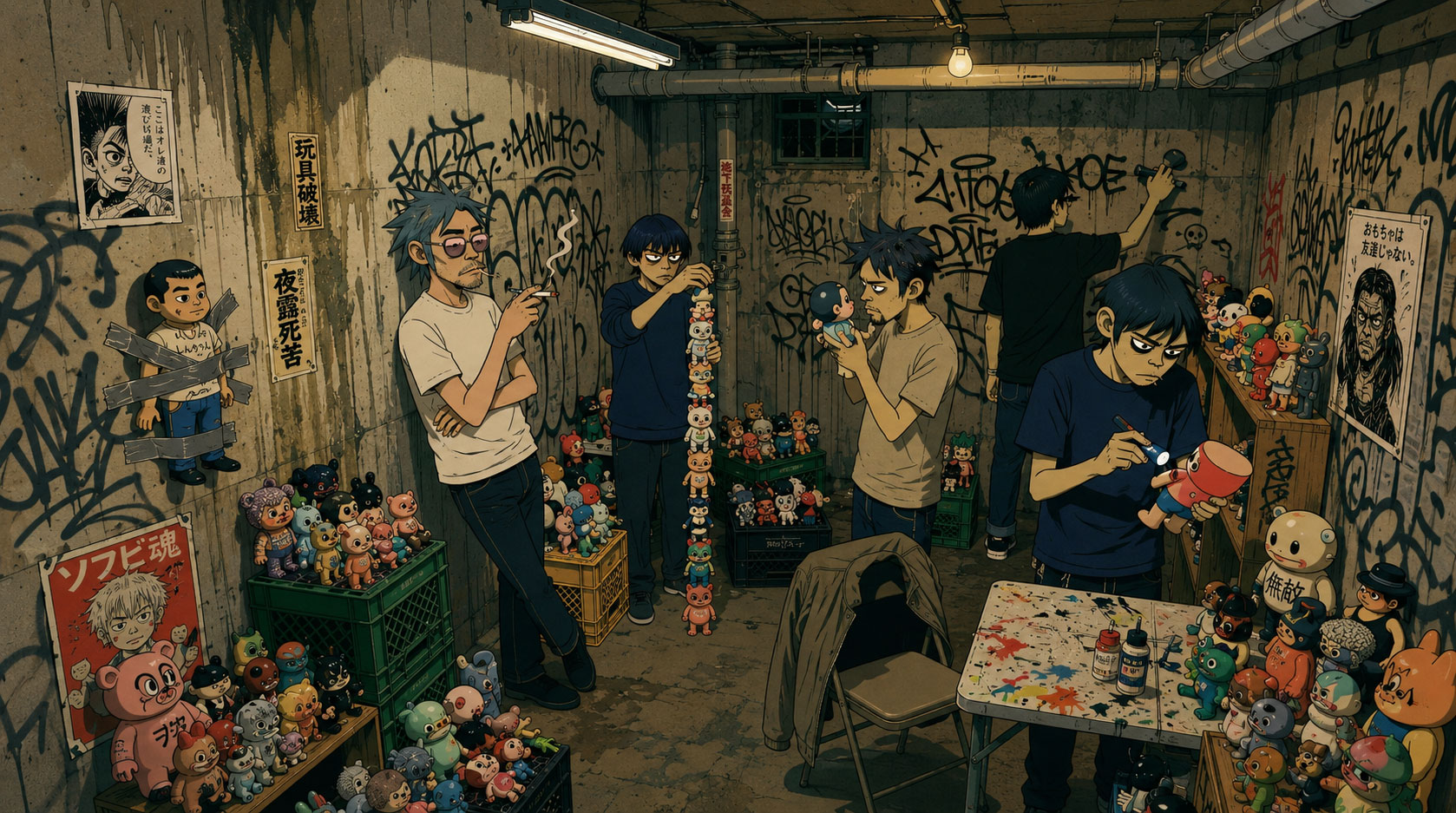

Somewhere between a Nordic elf and a dental nightmare, Labubu showed up and took over the world.
If you’ve been paying attention to anything outside your immediate lane — sneakers, streetwear, K-pop adjacency, the part of Instagram where people photograph their bag charms — you’ve seen it. Pointy ears. Asymmetrical eyes. A grin with too many teeth. Created by Hong Kong illustrator Kasing Lung in 2018, produced by Pop Mart, turned into a global phenomenon by 2025. Six hundred and seventy million dollars in the first half of 2025 alone. A hundred million units by the end of the year. BLACKPINK’s Lisa wearing one on her bag. Rihanna. Everyone.
And the graffiti world is largely ignoring it.
That’s a mistake.
Here’s what Kasing Lung actually is before he was a Pop Mart IP: an illustrator with a decade of practice deliberately blurring the lines between street art, toy design, and fine art. The sensibility behind Labubu isn’t K-pop merchandise energy — it’s the same restless need to put a character into the world and watch it develop its own mythology that drives anyone who’s ever picked up a can. The ugly-cute aesthetic, the mischief in the face, the sense that this thing exists slightly outside the rules of what a “nice” character should look like — that’s not corporate. That’s a writer’s instinct in a different medium.
Bearbrick is the reference point most graffiti-adjacent collectors reach for. And Bearbrick is correct — Medicom built something real, the collab history is deep, the culture connection is legitimate. But Bearbrick has been Bearbrick for twenty years. The conversation around it is established. Labubu is still being written.
The interesting version of Labubu isn’t the Lisa bag charm or the Disney collab. It’s the grassroots version — the Buenos Aires project where local artists created custom Labubu variants reflecting neighborhood stories, none sold commercially, all gifted to schools and community centers. It’s the fact that Kasing Lung’s original character was a visual diary entry made during a period of creative isolation. It’s the way the figure’s emotional ambiguity — that expression caught between mischief and melancholy — works as a canvas the same way a blank Bearbrick does.
The collector market is real. Resale premiums averaging 23% on StockX through 2025. Some limited editions hitting $2,000 and beyond. The same scarcity mechanics that drive sneaker culture, applied to a seven-inch creature with bad teeth. If you already understand why someone pays $400 for a 400% Bearbrick you already understand Labubu. The logic is identical.
What’s different is the entry point. Labubu is still accessible at retail in a way that 1000% Bearbricks haven’t been for years. The window where you can be early rather than late is closing but it hasn’t closed yet.
The graffiti world has always had an instinct for what’s culturally alive before everyone else arrives. That instinct built the connection to Bearbrick, to KAWS, to every designer toy collab that felt authentic rather than manufactured. Labubu is at the point in its trajectory where that instinct is useful — before the mainstream consolidation makes the conversation predictable.
Sleep on it if you want. But Sato saw it coming.
ALL CAPS. ALWAYS.
— Sato